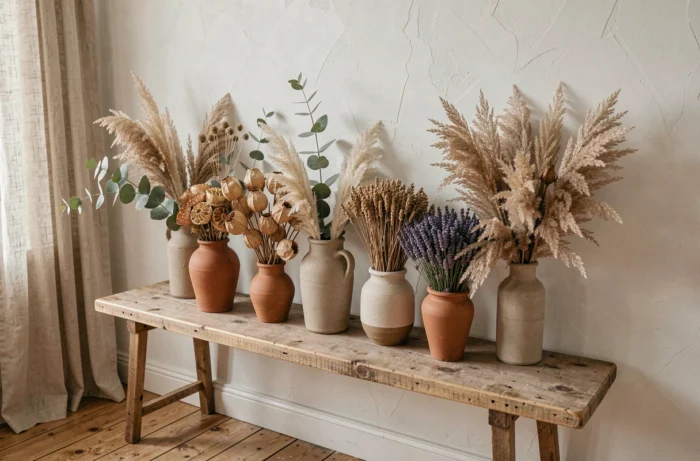
Dried flowers have been increasingly prominent in decoration aisles and at florists for several years. Their aesthetic, often associated with a bohemian or rustic style, appeals both for the variety of textures and the promise of a lasting bouquet. Behind this popularity, a few realities deserve closer examination, particularly regarding the actual longevity of these plants, their maintenance, and the precautions to take in certain households.
Actual lifespan of dried flowers indoors
Decorative content often presents dried flowers as a nearly permanent alternative to fresh bouquets. The reality is more nuanced. A dried flower retains its appearance for an average of one to two years, after which the color fades, the volume decreases, and the stems become brittle.
This degradation is not uniform. Varieties with thick stems (wheat, thistle, cotton) withstand better than fine grasses or delicate petal flowers like roses or statice. The final phase of fragility results in gradual crumbling, leaving residues on furniture and the floor.
Three factors accelerate aging:
- Direct sunlight discolors natural pigments within a few months, especially on bright shades (pink, orange, yellow).
- Ambient humidity, beyond a certain threshold, softens fibers and promotes mold growth, making bathrooms and kitchens less suitable.
- The dry heat from a radiator or stove speeds up residual dehydration and makes stems even more fragile.
Placing a bouquet in a hallway or a living room away from south-facing windows remains the most favorable configuration. A florist artisan like those found on maisonfloran.fr can guide the choice towards more resilient varieties based on the intended location.
Dust and allergens: a health angle often overlooked
Dried bouquets significantly retain dust. Unlike a living plant whose leaves can be easily wiped, dried flowers have irregular, porous, and sometimes fuzzy surfaces that trap airborne particles.
People sensitive to indoor air allergens should consider this factor. Plant particles that detach over time (petal fragments, residual pollen) can contribute to the allergenic load of a room, especially in bedrooms or poorly ventilated spaces.
To limit accumulation, regular dusting with a hairdryer on the cold setting, at low power, remains the most common method. Some florists also recommend turning the bouquet upside down and gently shaking it outside once a month. Field reports vary on the effectiveness of hair spray as a fixative, with some users noticing yellowing in the medium term.
Dried flowers and pets: varieties to watch
Drying does not neutralize a plant’s toxicity. Some species remain dangerous once dried, particularly for cats that tend to chew on accessible plants. Lily of the valley, lily, hydrangea, and delphinium are among the varieties to avoid in a household with pets.
Practical recommendations for pet owners include choosing heavy and stable containers (a wide ceramic vase rather than a thin glass bud vase), placing arrangements up high, and limiting elements that crumble or detach easily. Grasses, cotton, and lavender are considered safer options, although caution is still advised.
Dried flower decoration: composing a lasting bouquet
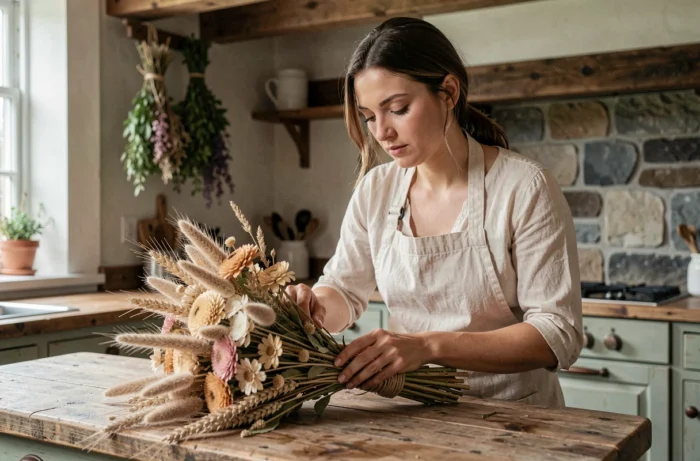
Composing a dried bouquet follows different principles than that of a fresh bouquet. Without water to maintain the flexibility of the stems, the structure of the bouquet sets within the first hours. Therefore, it is essential to work on the arrangement before placing it in its final container.
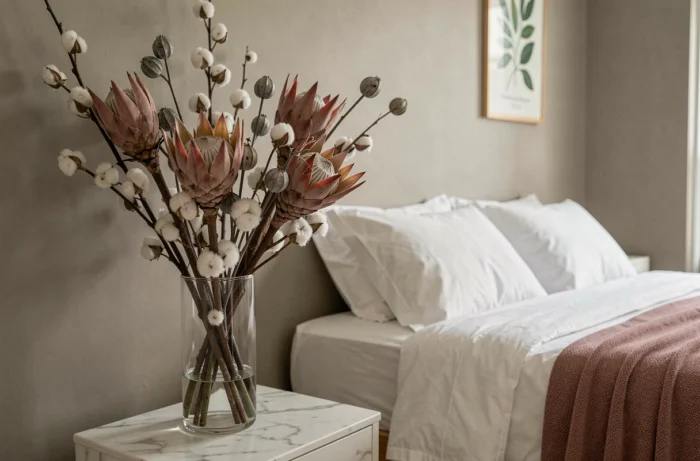
A balanced bouquet generally combines three types of stems: volume elements (pampas, gypsophila, thistle), structural stems (wheat, lavender, dried eucalyptus), and touches of color (craspedia, statice, immortelle). This combination creates visual depth that mono-variety bouquets do not offer.
The choice of container influences as much as the flowers themselves. An opaque vase conceals the often less aesthetic stems once dried, while a transparent vase is better suited for arrangements where the stems are part of the display (wheat, grasses). Glass cloches, very present in current trends, partially protect against dust but create a microclimate that can accelerate discoloration if exposed to light.
The ecological argument of dried flowers versus fresh bouquets
The sustainable aspect of dried flowers is often highlighted without precise comparison. Replacing a fresh bouquet every week generates more waste than a dried bouquet kept for a year, the calculation seems simple. However, available data does not allow for such easy conclusions.
The footprint of a dried bouquet depends on the origin of the flowers before drying. Locally grown flowers dried in the open air have a different impact than imported varieties that are then industrially treated (dyeing, anti-mold treatment, chemical stabilization). Stabilized bouquets, sometimes confused with dried flowers, involve the use of glycerin and dyes, the environmental impact of which remains poorly documented.
On the other hand, dried flowers eliminate the need for water and fertilizer post-purchase, which is a concrete advantage over potted plants or fresh bouquets requiring regular water changes.
Dried floral decoration offers a wide aesthetic palette and real durability, provided one accepts that it is neither eternal nor free of constraints. Choosing varieties suited to one’s interior, pets, and the brightness of the rooms remains the best way to enjoy them without unpleasant surprises.