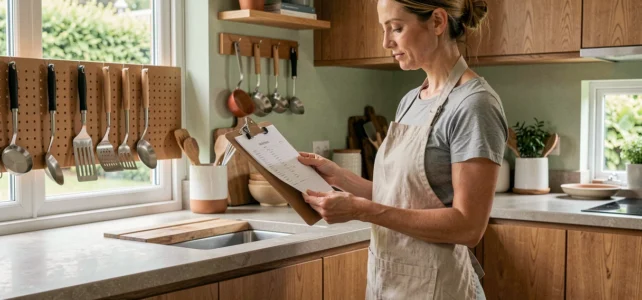
Equipping a home is not just about ticking off a list room by room. The choice of each item depends on how you actually live in your space, not on a standard catalog. It’s better to start from your daily habits to select the essentials for properly equipping your home, focusing on what will be used every day.
Office corner in the living room: a workspace that deserves a real plan
Do you sometimes work from home, even just a few hours a week? This scenario affects a significant portion of the workforce today. A home office is not a secondary accessory: if poorly designed, it can detract from the entire living area.
Cables lying around, a screen placed on the dining table, a kitchen chair that causes back pain after an hour. For several years, the rise of hybrid spaces has pushed manufacturers to design compact desks with closed storage and integrated charging ports. This furniture allows you to hide professional equipment at the end of the day.
To identify models suited to each configuration, the resources dedicated to home equipment on Maisons et Conseils detail the selection criteria based on the available space.
Three elements make the difference between an improvised corner and a real workspace:
- A chair with lumbar adjustment, even entry-level, that limits back tension from the first week of regular use.
- An adjustable light placed on the work surface, separate from the living room ceiling light, to reduce eye strain in the evening.
- A closed storage unit (drawer unit, low cabinet, or shelf with doors) that hides the computer, files, and cables once the day is done.
Kitchen appliances: start from your habits, not from a catalog
The kitchen often absorbs half of the equipment budget. The usual reflex is to buy everything on day one. A common result: a stand mixer that comes out of the cupboard twice a year.
Start with the appliances you will use every day. Refrigerator sized for the household, cooktop, kettle. The rest can wait a few weeks, time to observe your actual needs in this specific space.
The trap of the “first move package”
Some brands offer bundled sets: toaster, coffee maker, kettle, and microwave. The price seems attractive. In reality, the quality of each appliance is often mediocre, and you pay for items you may never use.
Buying each appliance separately allows you to upgrade on the ones that really matter. Do you cook every day? Invest in a good frying pan and a decent chef’s knife rather than a set of gadgets. For dishes, a service for four is sufficient at the start, with the rest being completed over the weeks.
Connected furniture and integrated charging: real comfort or premature purchase?
Low tables with wireless charging, sofas equipped with USB ports, headboards controllable by smartphone: recent catalogs multiply these offerings. Before dedicating a budget to them, the question of longevity deserves to be asked.
On the practical side, an integrated charging port in a piece of furniture avoids the proliferation of power strips on the floor. In a modest-sized living room or bedroom, the space-saving is real. Connected lighting systems also allow for varying ambiances without adding lamps.
The downside concerns durability. An electronic component integrated into a sofa ages faster than the furniture itself. In case of a malfunction, repairs are rarely straightforward. Opt for models where the connected module is removable or replaceable, rather than fixed within the structure.

Home equipment budget: spread purchases over three phases
Buying everything at once is tempting, but you don’t yet know your habits in this space. Natural light, room layout, and existing storage change your actual needs.
Phase 1: the days leading up to the move
Focus the budget on what you cannot sleep or eat without. Bedding, refrigerator, basic lighting, and cleaning kit form the bare essentials. Add curtains or drapes if the windows face the street.
Phase 2: the first two weeks
Concrete needs arise. A work surface that is too dark requires additional lighting. An entryway without hooks where jackets pile up on the sofa. This is the right time for complementary furniture: table, living room seating, storage.
Phase 3: after the first month
Comfort refines. Decoration, secondary appliances, occasional furniture. Each purchase then addresses an identified need, not a generic list. This gradual approach significantly limits unnecessary purchases compared to equipping everything at once, according to frequent feedback from layout advisors.
Durable materials and second-hand: a cost-effective equipping reflex
Durability in furniture is not just an ecological issue. A solid wood piece bought second-hand often costs less than a new particle board piece and lasts much longer.
Recycling centers and second-hand platforms offer functional small furniture at very low prices. A well-chosen second-hand piece protects the budget without sacrificing quality.
For textiles (curtains, bed linen, towels), new is still preferable for hygiene reasons. Check the fabric density: a sheet or towel that is too light wears out in a few washes and becomes more expensive in the medium term.
Home equipment is built over several weeks. The most useful purchases are those that meet a need identified after a few days on-site, not a supposition made before moving in.