
Lingerie is based on a simple technical principle: a well-fitted undergarment visually redistributes the proportions of the bust and hips, while a poorly chosen model compresses, marks the skin, or distorts the silhouette under clothing. The choice depends on three measurable parameters (band size, bust size, hip size) and one often overlooked parameter, the shape of the cup in relation to the breast root.
Understanding the role of the band size in bra support
The majority of a bra’s support comes not from the straps, but from the band. A band that is too loose forces the straps to compensate, which digs into the shoulders and lifts the back of the bra.
To check the fit, slide two flat fingers under the band at the back. If you can fit more fingers, the band size is too large. The band should remain horizontal, parallel to the ground, even when you raise your arms.
This simple test eliminates a large portion of sizing errors. The cup only comes into play afterward: a cup that wrinkles indicates excess volume, while a breast that spills over the side signals insufficient volume or an unsuitable shape. The catalogs available on lingerie-seduction.com allow for comparison of different cup styles by filtering by band size, making it easier to sort before trying on.
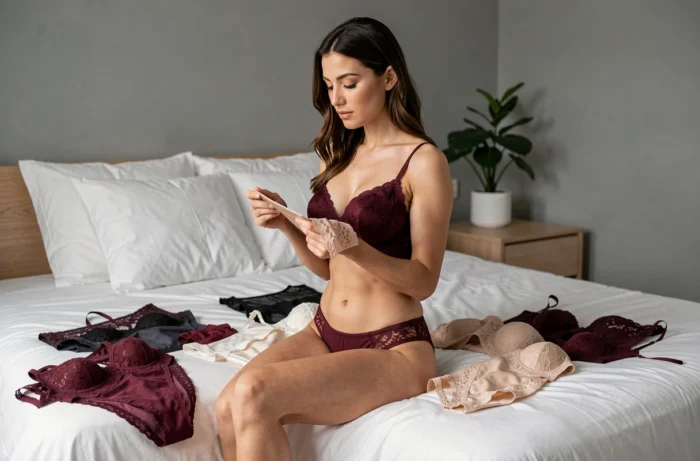
Materials and construction: what really changes daily comfort
Competitors often talk a lot about body shapes (A, V, X, H, O silhouettes), but rarely about the construction of the undergarment. Yet it is this that determines the sensation worn throughout a full day.
Underwires, molded cups, and triangles
Rigid underwires distribute the weight of the bust towards the band. They are suitable for generous busts that need firm support. However, a wire whose curvature does not match the breast root presses on the breast tissue and causes red marks by the end of the day.
Molded cups smooth the silhouette under a fitted garment and mask volume variations related to the hormonal cycle. They offer less flexibility than triangles, which remain the most comfortable format for smaller busts, as they impose no predefined shape on the breast.
The choice of fiber
- Breathable cotton is suitable for daily use but loses its shape after many washes, especially if the fabric is thin.
- Synthetic microfiber (polyamide, elastane) retains its elasticity longer and dries quickly, making it suitable for active days.
- Lace adds an aesthetic dimension, but its durability depends on the number of threads per centimeter: dense lace withstands friction better than loosely woven lace.
A good habit is to check the composition on the label. The European regulation on ecodesign (ESPR, adopted in 2024) will indeed establish a digital passport for textile products starting in 2027. This system, accessible via a QR code, will provide information on the origin, composition, and recyclability of each piece of lingerie.
Underwear and stockings: adapting the cut to hip height
The lower body is often treated as a purely aesthetic choice (thong, shorty, classic panty). In reality, the placement of the waistband alters the perceived silhouette under a garment.
A high-waisted panty smooths the abdominal area and creates a gentle transition between the belly and hips. It is particularly suitable for silhouettes where the hips are wider than the shoulders, as it visually elongates the torso.
The shorty covers the tops of the thighs and limits demarcations under fitted pants. The thong, on the other hand, eliminates visible lines but offers no sculpting effect.
A common pitfall: choosing a size smaller for a shaping effect. A waistband that is too tight creates a bulge above the waist and marks the skin, producing the opposite effect of what is desired.

Environmental claims about lingerie: what will change
In recent years, lingerie brands have been increasingly using “eco-friendly” or “sustainable” labels on their packaging. The European EmpCo directive (directive (EU) 2024/825), applicable from September 27, 2026, will strictly regulate these practices.
Generic claims like “eco-friendly,” “green,” or “climate friendly” will be prohibited without detailed evidence or recognized eco-labels. Promises of “carbon neutrality” based solely on offsets will also be banned.
For a buyer, this regulation means that labels will gradually become more reliable. Within two years, comparing two brands on their environmental commitments will be easier, as vague formulations will have disappeared from European shelves.
Bra size and confidence: the concrete link
Wearing a bra in the correct size changes posture. Proper support prevents the shoulders from rolling forward, which opens the chest and straightens the back. This postural change is immediately visible in how a garment falls on the bust.
The effect on confidence is not abstract: lingerie that doesn’t slip, compress, or distort is forgotten throughout the day. It is precisely when the undergarment disappears from consciousness that it fulfills its function.
Taking measurements at least once a year remains the most direct method to avoid the gradual mismatch between the size worn and the actual size, which variations in weight, pregnancy, or simply time can alter without one noticing.