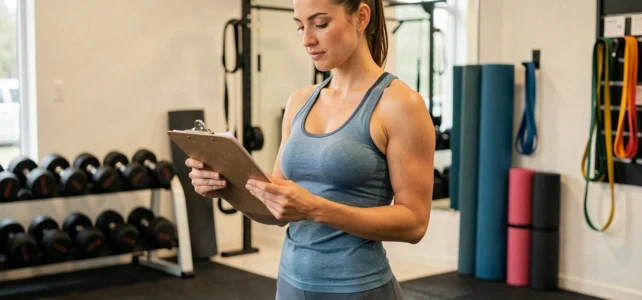
Sports coaching relies on the coach’s ability to offer varied exercises, tailored to the client’s level, in locations that change from one session to another. The equipment serves a specific function: to enable a complete body workout (strength training, cardio, mobility) with portable gear. Before assembling their kit, a coach needs to understand what truly shapes their purchasing decisions.
Portability of Coaching Equipment: The Criterion That Conditions Everything
An independent sports coach rarely works in a fixed location. The client’s home, a park, a studio rented by the hour: each context requires that all equipment fits into a sports bag. This parameter immediately eliminates heavy loads and bulky machines.
The real purchasing filter is not price, but the ratio of bulk to versatility. A set of resistance bands covers as many muscle groups as a dumbbell rack, for a negligible weight. A TRX suspension strap allows for core, pulling, and pushing exercises by attaching to a branch or a door.
Before any purchase, it is possible to discover the equipment on Quel Coach to compare options based on their portability and usage in sessions.
A well-filled 60-liter bag covers the majority of sessions. Anything that does not fit within this volume should be reconsidered, unless the coach has a permanent studio.
Strength and Conditioning Equipment: The Pieces That Really Matter
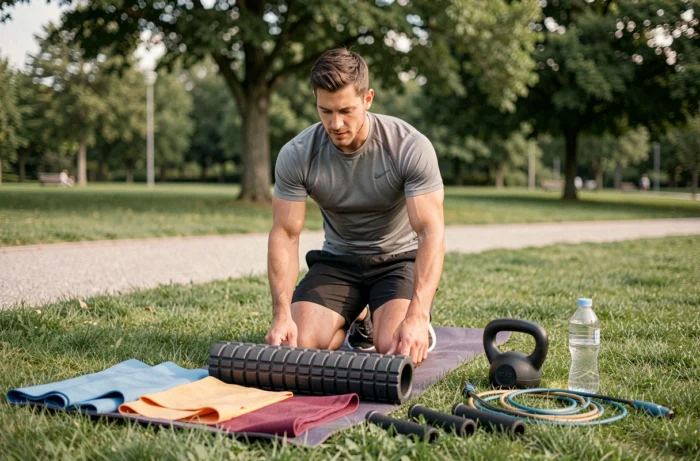
Competitors often list dozens of accessories. In practice, most sports coaching sessions utilize a limited core of equipment. It is better to invest in the quality of this core than in quantity.
Variable Resistance: Bands and Suspension Straps
Progressive resistance bands are the first purchase to consider. They allow for a complete strength training workout (biceps, shoulders, glutes, back) with adjustable resistance. A set of five resistance levels is sufficient to cover both beginners and advanced practitioners.
The suspension strap complements this duo by adding bodyweight exercises with variable incline. It consistently works the core, even during pulling or pushing movements.
Free Weights: Kettlebells and Adjustable Dumbbells
For home or studio sessions, two kettlebells of different weights allow for strength and explosive training (swings, squats, Turkish get-ups). Adjustable dumbbells offer a finer weight range, suitable for isolation exercises.
Buying in pairs of two different weights covers more needs than a single heavy weight. A beginner coach does not need the entire range: two weights are sufficient for the first few months.
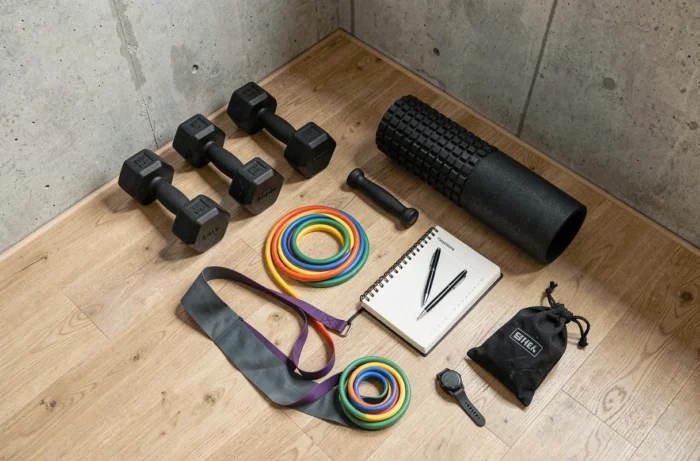
- A set of resistance bands with five levels of resistance, for muscle strengthening and joint warm-up
- A suspension strap, for bodyweight training anywhere
- Two kettlebells of different weights, for strength and ballistic exercises
- A pair of adjustable dumbbells, for isolation movements and load progression
Comfort and Monitoring Equipment for Sports Sessions
Beyond strength equipment, some accessories structure the quality of the session without adding exercises. The exercise mat is one of them: it defines the workspace, protects joints on the ground, and sets a professional framework.
A foam roller is used for myofascial warm-up and cool-down. Its usefulness goes beyond simple comfort: it prepares the muscles for effort and speeds up recovery between sets.
For tracking the pace of sessions, a dedicated timer (like Gymboss) is more reliable than a phone, which can create distractions. A coach offering HIIT or Tabata workouts needs a clear sound signal to mark intervals.
Monitoring equipment distinguishes structured coaching from a mere demonstration of exercises.
Professional Liability Insurance and Legal Obligations Related to Sports Coach Equipment
Equipment lists almost always omit a direct regulatory point: professional liability insurance is a legal requirement for any paid sports coach in France, regardless of the legal form (micro-enterprise, SASU, EURL). This insurance covers bodily, material, and immaterial damages caused to clients by exercises, advice, or equipment used during sessions.
A band that breaks and injures a client, a kettlebell that slips on a waxed floor: professional liability insurance comes into play in these scenarios. Without it, the coach takes on personal responsibility for all costs.
Coaching Studio and ERP Standards
As soon as a coach operates a studio or a group class room, the location becomes a public establishment (ERP type X). The obligations then exceed the simple choice of fitness accessories:
- Mandatory safety register with periodic checks
- Sufficient number of fire extinguishers, checked annually
- Display of diplomas, professional card, and insurance certificate
- First aid kit and means of communication to alert emergency services
These constraints condition the layout of the place even before considering training equipment. A coach renting a studio by the hour in a shared space does not have these obligations, as it is the operator of the location who bears them.
The equipment of a sports coach is not just a list of accessories stored in a bag. Professional liability insurance is part of the equipment just like an exercise mat: without it, no session should take place. On the equipment side, a limited core of versatile and portable accessories covers the vast majority of needs, from the first client to the twentieth.