
The fare reform that came into effect on January 1, 2025, has profoundly reshuffled the Navigo zoning cards. Single tickets have become flat-rate across the entire Île-de-France region, making the reading of zones less crucial for occasional trips on the metro, RER, or train. For subscribers to the Navigo Weekly, Monthly, or Annual pass, the division into five concentric zones remains the central pricing mechanism.
End of paper tickets and transition to digital ticketing in 2026
Old paper tickets gradually disappeared in 2026, replaced by dematerialized supports. This shift changes the practical question faced by users: it is no longer just about choosing the right zone, but also about selecting the right payment method (physical Navigo card, smartphone app, Navigo Easy pass).
The Navigo Easy, a rechargeable card without a photo or subscription, now absorbs the use cases of the old booklet of tickets. It accepts single tickets and certain day passes, but not Weekly or Monthly passes. We recommend reserving it for irregular trips or for visiting guests.
On the smartphone side, the annual Navigo began to be dematerialized on Android in 2026, then on iPhone via the Cards app. This advancement eliminates the need to go to a ticket counter or kiosk to recharge the pass, provided one has a compatible NFC phone.
For users who consult the Navigo zone map in Paris before choosing their plan, the dematerialization does not change the geographical scope covered by each zone. However, it significantly simplifies daily management.

Navigo all zones pass or restricted pass: real financial arbitration
The Navigo all zones pass (1-5) remains the default choice for the majority of residents in Île-de-France. Île-de-France Mobilités has aligned the prices to make this option attractive compared to the old passes limited to two or three zones. As a result, a subscriber who primarily travels in zones 1-2 pays almost the same price as a user covering all five zones.
The interest in a restricted pass (zones 2-3 or 3-4, for example) is only justified in one specific case: a home-to-work trip entirely contained within these zones, without any passage through Paris intra-muros. In practice, we observe that this profile mainly concerns workers in the Greater Crown who work in a city of the Petite Crown without passing through Parisian stations.
Criteria for deciding between zonal pass and all zones
- Check if the daily route crosses zone 1 (Paris), in which case the all zones pass is necessary
- Compare the monthly price difference with the cost of a few single tickets outside the zone for occasional trips to Paris
- Consider weekend trips to airports (CDG in zone 5, Orly accessible via the classic network in zone 4) or tourist sites in the Greater Crown
For employees, employer reimbursement covers half of the pass, which further reduces the gap between the two options. A restricted pass only generates significant savings if the user never leaves their zones.
Validation traps at zone boundaries on the RER network
The RER network crosses several zones on the same line, and this is where validation errors can be costly. A zones 1-3 pass allows free travel between Paris and the stations located in zone 3. Exiting in zone 4 without a valid ticket exposes one to a flat fine during a check.
The most common trap concerns the RER B to Charles de Gaulle airport. The CDG station is located in zone 5. A zones 1-3 subscriber who takes this train without a supplementary ticket is in violation as soon as they exceed the limit of their zone. The same issue arises on the RER A beyond Marne-la-Vallée (zone 5, access to Disneyland Paris).
Exit validation: a mechanism often ignored
Unlike the Paris metro where validation occurs only at entry, RER and Transilien stations require validation at both entry and exit. Forgetting to validate upon exit can trigger a block on the pass for the next trip or, in some cases, a default charge at the maximum rate on the new ticketing systems.
We recommend that users who alternate between metro and RER develop the systematic reflex of double validation. The exit gates at RER stations are not always visible, especially in stations under construction or temporary stops.
Navigo on smartphone: technical limits to know
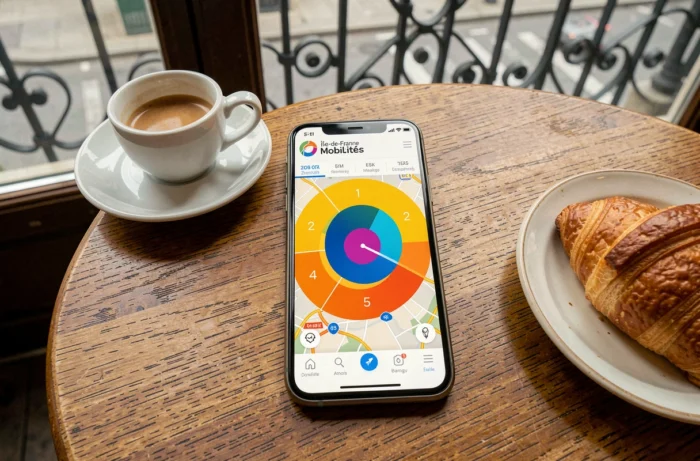
The dematerialization of the annual Navigo on phone represents a long-awaited advancement. On Android, loading is done through the Île-de-France Mobilités app. On iPhone, the pass is integrated into the Cards app via Apple Wallet.
Several constraints remain:
- The Navigo Weekly and Navigo Monthly are not yet available on smartphone, limiting the option to annual subscribers
- The phone must have an active NFC chip, sufficient battery, and a recent version of the operating system
- In case of a breakdown or dead battery, no backup ticket is accessible, unlike the physical card which works without power
- Transferring a pass from a physical card to a smartphone (or vice versa) requires a visit to an agency or an online process with a delay
Keeping a physical Navigo card in addition to the smartphone remains prudent for users who make long trips in zones 4-5 where a dead phone would pose a validation issue upon exit.
The Navigo zoning remains highly relevant for subscribers, even though the pricing of single tickets has been simplified. The real lever for savings in 2026 no longer lies in the choice of zone, but in the choice of support and type of pass, depending on the regularity of trips and the lines taken.