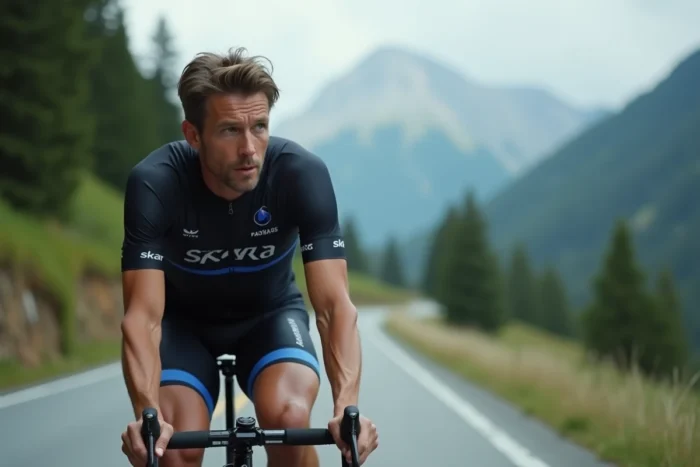
Torstein Traeen donned the yellow jersey of the Tour de France 2026 during the fourth stage, between Carcassonne and Foix. The Norwegian from the Uno-X Mobility team took the lead in the general classification from Tadej Pogacar by taking advantage of a long breakaway.
What sets this yellow jersey apart from others is the four years that separate it from a diagnosis of testicular cancer. How can one measure the trajectory of a rider who went from a medical halt to the top of the world’s greatest cycling tour?
Accidental screening through doping control: Traeen’s medical timeline
Torstein Traeen’s cancer was not discovered during a routine examination. It was a doping control that revealed an abnormally high level of a hormone that could indicate a testicular tumor. The rider had also reported testicular discomfort, which expedited the care process.
The tumor was diagnosed at an early stage. Surgery took place quickly, and according to several sources, no chemotherapy was necessary. Traeen was away from the pelotons for about four months before resuming training.
This medical journey reframes the often simplified narrative presented by the media. The Traeen case is not just a story of sporting resilience. It is also a concrete example where a sports control system played an involuntary screening role, and where a subjective symptom reported by the patient contributed to a rapid diagnosis.
To better understand Torstein Traeen’s fight against cancer, this sequence must be placed in the broader context of his career with Uno-X Mobility, the team that has supported him since his professional beginnings.

Performance before and after diagnosis: comparative table
One of the least addressed angles by competitors is the concrete measurement of Traeen’s progress between his pre-cancer period and his return to the highest level. The available data allows for a factual overview.
| Period | Notable Result | Team |
|---|---|---|
| Before diagnosis (before 2022) | One professional victory, domestic climber profile | Uno-X |
| Post-operation return (2022-2023) | 2023 Tour de France raced with a fractured elbow | Uno-X Mobility |
| Time with Bahrain-Victorious | Two seasons without major results in stage races | Bahrain-Victorious |
| Return to Uno-X (2025) | Red leader’s jersey on the Vuelta for four days | Uno-X Mobility |
| Tour de France 2026 | Yellow jersey taken from Pogacar during the 4th stage | Uno-X Mobility |
This table shows that Traeen’s trajectory is not linear. His time with Bahrain-Victorious did not yield results comparable to those achieved with Uno-X. In contrast, his return to the Norwegian team coincides with his two most notable performances in Grand Tours.
Testicular cancer and high-level sports: what the Traeen case changes in the screening debate
Most articles dedicated to Traeen focus on the emotional aspect of his return. The medical and preventive angle deserves a more precise analysis.
- Screening for testicular cancer is not part of the systematic examinations for professional athletes. It was the doping control, designed to detect banned substances, that alerted Traeen’s medical team.
- The rider had reported physical discomfort even before the test results, highlighting the importance of reporting subjective symptoms, even in an environment where pain is normalized.
- Early surgical intervention prevented the need for chemotherapy, significantly reducing downtime and potential physical aftereffects.
Traeen himself stated after donning the yellow jersey: “I hope this gives hope to those who suffer.” This phrase, echoed by several French-speaking media outlets, places the rider in a role of awareness that he did not seek but accepts.
The parallel with other cases of athletes affected by testicular cancer exists, but Traeen’s uniqueness lies in the mode of discovery. A doping protocol transformed into an involuntary screening tool raises a concrete question: should the biological markers monitored during these tests be expanded to include indicators of non-doping-related pathologies?
Uno-X Mobility and the yellow jersey: a team context not to be overlooked
Traeen is the third Norwegian in history to wear the yellow jersey of the Tour de France, after Thor Hushovd and Alexander Kristoff. Hushovd, now manager of Uno-X Mobility, is directly involved in building the team that achieved this result.
Traeen’s loyalty to this structure, aside from his two seasons with Bahrain-Victorious, highlights a rarely emphasized fact: his best performances coincide with his environment at Uno-X. The red jersey on the Vuelta 2025, and then the yellow jersey on the Tour 2026, were both achieved under the colors of the Norwegian team.
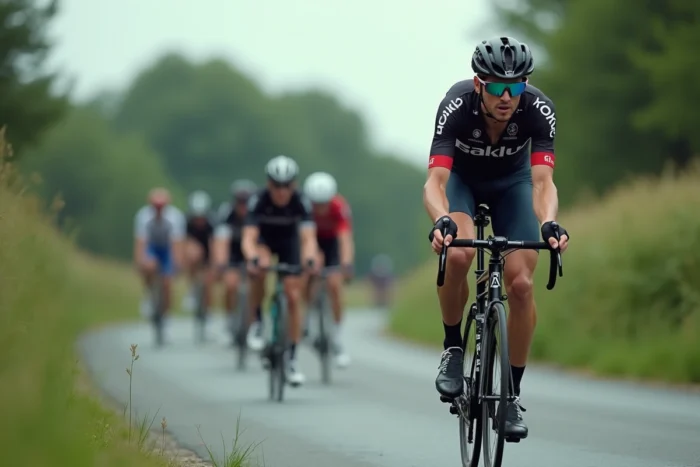
The strategy used during the fourth stage recalls that of the Vuelta: taking advantage of a long breakaway to gain time in the general classification. This approach, typical of riders who do not have a full train of teammates to control the race, reflects Uno-X’s positioning against larger teams like UAE Team Emirates or Visma-Lease a Bike.
Extreme heat and racing conditions at the Tour 2026
The climatic context of this fourth stage deserves mention. The Tour 2026 took place in extreme heat that constituted an additional selection factor. Traeen’s taking of the yellow jersey occurred under conditions where effort management and physical endurance played an increased role, far beyond mere climbing power.
The route between Carcassonne and Foix, in the heart of Cathar country, put the bodies to the test. Traeen, eighth in the stage, secured his position in the general classification without necessarily dominating in the final sprint, confirming a profile of a rider calibrated for consistency rather than explosiveness.
Torstein Traeen’s yellow jersey at the Tour de France 2026 carries a dual interpretation. The first is sporting: a climber with a modest record capable of competing with Pogacar in the general classification thanks to a breakaway tactic. The second is medical: an early diagnosis obtained through an unexpected channel allowed for a complete return to competition. This combination makes the Traeen case a subject that transcends the realm of cycling.