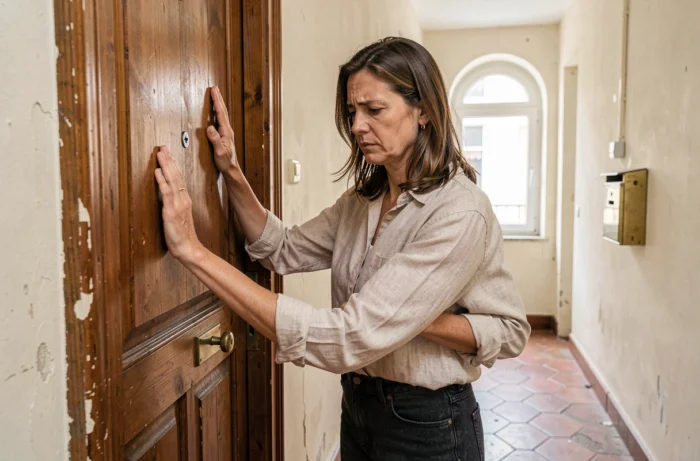
You come home with your arms full of shopping, a draft slams the door shut, and your keys are still on the console in the hallway. Or you search your pockets outside the building and can’t find your keyring. These situations affect a considerable number of French households every year, and how you respond in the first few minutes makes all the difference: the wait, the bill, and sometimes the condition of the door itself.
Door slammed shut without being locked: check a few things before picking up the phone
When the door has simply slammed shut (the latch has engaged, but the key hasn’t been turned), the lock isn’t locked. You’re dealing with a fairly simple mechanical obstacle. Before calling anyone, a few quick checks could save you the cost of a callout.
First, check the other entrances. A service door, a balcony sliding door, or a ground-floor window left ajar. We often underestimate this simple step because stress can cloud our judgment. Next, if you live in an apartment building, the caretaker or a trusted neighbor may have a spare key.
As the advice from Maestro Immo points out, the plastic-card technique (sliding a rigid plastic sheet between the door frame and the door to push back the latch) works on most apartment entrance doors that aren’t locked. It won’t work if an additional lock has been engaged or if the door has an anti-lift latch.
A door that has slammed shut without the key being turned can often be opened again without a locksmith. Professional help is needed when the mechanism is actually locked, jammed, or damaged.
Lost or broken key in the lock: two situations, two levels of urgency
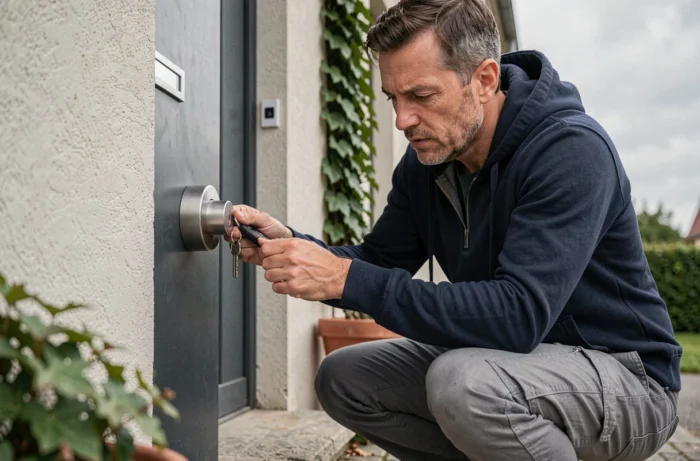
Losing your keys doesn’t create the same urgency as having a piece of key stuck in the cylinder. In the first case, you may have some time: contact your home insurer, find a spare key, or get in touch with someone close to you. In the second, the mechanism is physically jammed, and the door can only be opened with the right tool.
Lost key: call your insurer before calling a locksmith
Most home insurance policies include lost-key coverage or an assistance service that covers door opening, at least in part. Calling your insurer first may mean they cover the locksmith’s callout. You’ll find the assistance number on your insurance certificate or in your insurer’s app.
If your insurer sends a contractor, you still have the right to request a written estimate before work begins. This is non-negotiable, even in an emergency.
Broken key: don’t force the cylinder
If part of the key is sticking out of the lock, you may be able to remove it with a pair of fine long-nose pliers. If the fragment is pushed too far in, trying to force it out with a screwdriver or metal object could damage the cylinder. Simply removing the fragment costs far less than replacing the entire cylinder.
Written estimates and additional work: what the locksmith must do on site
Residential locksmith services are subject to specific rules. A written estimate is required before any work begins, even for a low-cost callout. It must itemize the planned services, parts used, and travel costs, and show all prices including tax.
One point rarely covered in practical guides: what happens when the locksmith discovers an additional problem after arriving? For example, while opening the door, they notice that the multipoint locking mechanism is worn or that the cylinder shows signs of weakness.
Distinguishing urgent repairs from additional work
The legal rule is straightforward. The locksmith is hired to resolve the problem that prompted the call: open the door, remove a piece of broken key, or release a jammed latch. Any service beyond that initial scope counts as additional work.
- An urgent repair is work that must be done to close or secure the door that evening (for example, replacing a cylinder damaged while opening the door).
- Additional work (replacing a multipoint lock, installing a security door, or upgrading an aging mechanism) must be covered by a separate estimate, which you are free to accept or decline.
- You can ask to keep the replaced parts (the old cylinder or lock barrel) so you have tangible proof of what was actually changed.
An emergency service explicitly requested by the customer is not automatically covered by the 14-day cooling-off period. This exception applies only to urgent maintenance or repair work. It does not justify additional work unrelated to the original emergency. If a contractor refuses to separate the services or insists on doing everything at once without providing a new estimate, that’s a red flag.
Emergency locksmith: practical ways to avoid unpleasant surprises
When you’re stressed, it’s tempting to call the first sponsored result on your phone. Locksmith scams rely on exactly this kind of haste.
A few quick checks can help you vet a locksmith before confirming a callout:
- The locksmith has a verifiable SIRET number and a physical address. A phone number alone, with no website or legal information, offers no guarantee.
- The estimate is provided before the locksmith sets out, or at the latest before work begins. A reputable professional won’t object to this step.
- The callout fee and hourly rate are clearly stated, including any night or weekend surcharges.
- If there’s a dispute after the work (an inflated bill or unauthorized work), you can report the issue to the DGCCRF through the SignalConso platform, which forwards the report to the professional concerned.
Using a locksmith recommended by your insurer or building manager significantly reduces the risk of hiring a dishonest contractor, since these intermediaries have already vetted their tradespeople.
One last tip to remember: once the door is open and the situation is under control, make a spare key and leave it with someone you trust. It’s the best way to prevent another lockout.