
An appointment with an optician is about more than reading letters on a chart. The quality of the consultation depends largely on the information you provide about how you use your vision every day. Preparing for your appointment helps the optician tailor your prescription not to theoretical visual acuity, but to the real-world demands of your vision.
Multifocal prescriptions and switching between activities: what your optician needs to know
When you switch from a screen to driving and then to reading in the same day, each activity uses a different area of your progressive lenses. Your optician cannot guess which situations are causing problems unless you describe them clearly.
For a few days before your appointment, make a note of when your vision bothers you. Avoid vague impressions and focus on specific situations: blurred intermediate vision on screen after two hours, discomfort when shifting focus from the dashboard to the rear-view mirror, or eye strain after reading for a long time in the evening.
This record of how you use your vision helps your optician choose a lens design that suits you. Progressive lenses do not all have the same corridor width or the same distribution of distance, intermediate and near-vision zones. Someone who works at a screen for eight hours a day needs a different corridor from a long-haul driver. By describing your usual working distances (arm’s length, mid-distance, close reading), you can help guide the choice towards the most suitable lens geometry.
Among the tips for preparing for an appointment with your optician, keeping a visual diary is still one of the most overlooked. It turns a general conversation into a focused consultation.
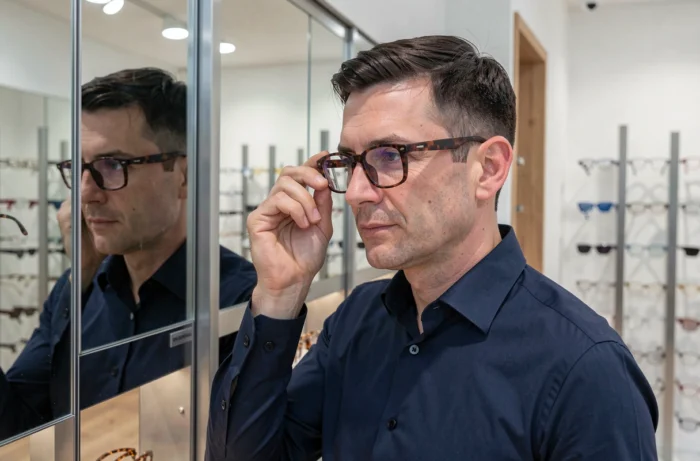
Eye prescription: review and understand the details before your visit
Bring your current prescription. In France, its validity period varies by age: it is shorter for children under sixteen and longer for adults. Check the date before you set off.
But don’t stop at checking the date—take time to understand what’s on the prescription. The sphere, cylinder and axis values describe your correction, while the addition indicates the extra power needed for near vision. Knowing these values helps you ask your optician specific questions, especially if you’ve noticed that your prescription no longer works well for certain tasks.
What to gather before your appointment
- Your original eye prescription, including sphere, cylinder, axis and addition if applicable, as well as the prescription date
- Your current glasses (even if damaged), as your optician can measure the lenses with a lensmeter and compare them with the new prescription
- Your health insurance card or third-party payment certificate, so the quote can include your coverage directly
- The name and reference of your current lenses, if available, to identify which coatings (anti-reflective, photochromic, blue-light filter) they have
Comparing your old prescription with the new one helps your optician anticipate how long it may take you to adjust, especially if the addition in your progressive lenses has changed.
Choosing frames and lenses: technical factors to consider
Appearance matters, but it should not take priority over compatibility with your prescription. Frames that are too small limit the fitting height of progressive lenses, reducing the reading area. Highly curved frames make it harder to centre lenses for strong prescriptions.
Your optician measures your pupillary distance and fitting height to centre the lenses in line with your visual axes. A lens decentration of just one millimetre can cause daily discomfort, especially with a high addition. Avoid choosing frames online without having these measurements taken.
Lens coatings: separating comfort from marketing
Multilayer anti-reflective coatings reduce unwanted reflections and improve light transmission. Blue-light filters, often recommended for screen use, remain a subject of debate in the scientific community regarding their actual benefits for eye strain.
By contrast, scratch-resistant and hydrophobic coatings have a direct impact on lens durability. If you wear your glasses all the time, scratch-resistant and hydrophobic coatings can measurably extend the life of your lenses.
- Anti-reflective: useful for night driving and screen work; reduces halos
- Photochromic: convenient if you frequently move between indoors and outdoors, although transition time varies with temperature
- Polarised (for sunglasses): eliminates reflections from flat surfaces (water, wet roads), but is incompatible with some head-up displays
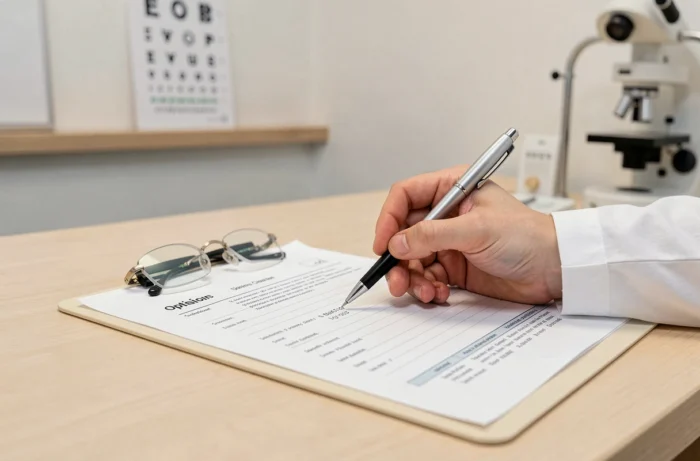
Orthoptic assessment before your eye-care appointment: still an uncommon but useful step
An orthoptic assessment evaluates how your eye muscles work, as well as convergence and binocular coordination. These factors directly affect comfort with corrective lenses, particularly when using screens.
An undetected convergence problem may explain eye strain that neither an ophthalmologist nor an optician can resolve with corrective lenses alone. An orthoptist identifies muscle imbalances that interfere with binocular vision and can prescribe vision therapy or recommend prisms incorporated into your lenses.
If you experience headaches at the end of the day, occasional double vision or difficulty keeping your place while reading, tell your optician. They can refer you to an orthoptist before finalising your glasses. Adjusting lenses when binocular vision is unstable is like treating a symptom without addressing its cause.
Preparing for an appointment with your optician ultimately comes down to one simple principle: the more clearly you describe how you use your vision and what bothers you, the better your final eyewear will suit your visual needs. Good eyewear does more than correct visual acuity—it adapts to your life.