
Are you preparing your wedding in Brittany, the Pays de la Loire, or Normandy for 2026? Before choosing the caterer or the reception venue, there is an administrative step that conditions the validity of your union: the publication of the bans. This formality, governed by the Civil Code, has notable practical developments in the municipalities of western France, between traditional posting at the town hall and online publication on municipal websites.
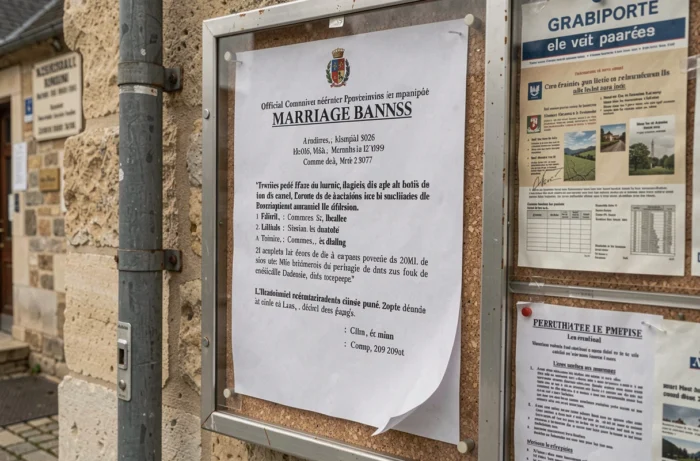
Digital Posting of Bans at the Town Hall: A Local Practice Without a National Framework
Most wedding guides describe the publication of the bans as a simple paper display at the town hall door. In 2025 and 2026, the reality in the West is more nuanced.
Several medium-sized municipalities now publish the bans both physically at the town hall and online, in the “civil status” or “recent administrative acts” section of their website. This dual publication is not mandated by any national text. Each town hall manages its own bans without centralization. There is no national database where announcements can be consulted.
If you want to better understand the local rules governing the publication of marriage bans in Western France, the topic deserves special attention, as practices vary from one municipality to another.
In practical terms, this means that a couple whose future spouses reside in two different municipalities (for example, Rennes and Nantes) will see their bans posted in both town halls, but according to modalities that may differ: one may offer online posting, while the other may not. Check directly with each concerned town hall for the applicable posting modalities.
Marriage File and Bans: The Calendar to Follow in the West
Before publishing the bans, the town hall must first receive and validate your complete marriage file. Here are the documents generally required:
- A birth certificate issued within the last three months (six months if issued by a consulate) for each future spouse
- A valid form of identification
- A proof of residence or domicile
- The list of witnesses with their complete contact details
- If applicable, a marriage contract drawn up by a notary
Once the file is validated, the civil status officer orders the publication of the bans. The posting lasts a minimum of ten days, during which anyone can report a legal impediment to the marriage.
In practice, town halls in the West often recommend submitting the complete file at least two months before the desired date. This timeframe takes into account exchanges between town halls when the spouses do not reside in the same municipality, as well as potential postal delays in obtaining birth certificates.
What Most Often Delays the Files
An expired birth certificate at the time of submission is the most common cause of delay. The three-month period starts from the date of issuance, not from the date of birth. If your wedding is planned for September 2026, a certificate requested in May remains valid, but a certificate obtained in March may no longer be valid at the time of the ceremony.
For individuals born abroad, the process is longer. A certificate of capacity to marry may be required by the consulate, and the processing times can sometimes take several weeks.
Opposition to Marriage After Publication of Bans: Who Can Act and How
The publication of the bans is not just a formality of posting. It opens a right of opposition governed by the Civil Code. During the posting period, certain individuals can oppose the marriage if they believe a legal impediment exists.
In practical terms, those authorized to file an opposition are ascendants (parents, grandparents) and, in some cases, the public prosecutor. A friend or neighbor cannot block a marriage by filing an opposition: only individuals provided for by law have this right.
The opposition must be based on a real impediment: an undissolved previous marriage, a prohibited kinship, or the absence of free consent from one of the future spouses. If an opposition is filed, the marriage cannot be celebrated until it has been lifted, either by the withdrawal of the opponent or by a decision of the judicial court.

Validity of Bans and Postponed Marriage: What the Civil Code Provides
You have set a date, the bans are published, and then an unforeseen event forces you to postpone the ceremony. What happens?
The marriage bans remain valid for one year from the end of the posting period. After this period, the procedure must be restarted: new file, new publication. This point is often overlooked by future spouses who postpone their ceremony by a few months without considering the question.
For couples in the West who book highly sought-after reception venues (castles in Loire-Atlantique, estates in Ille-et-Vilaine), postponing the wedding date beyond a year may therefore lead to a double administrative process. It is better to publish the bans only once the date is firmly set.
Marriage Celebrated in a Different Municipality from Domicile
Do you reside in Brest but wish to marry in Vannes, in a relative’s municipality? The Civil Code allows this, provided that one of the future spouses or one of their parents is domiciled there or has resided there continuously for at least one month. The bans will then be published in both municipalities: that of the marriage and that of each spouse’s domicile.
The celebration town hall verifies the link of attachment itself. In practice, a proof of residence or a residence certificate from the parent is sufficient in most cases.
The publication of the bans remains in 2026 a simple step on paper, but it requires anticipation, especially when multiple town halls are involved. Online posting practices are developing in the West without national harmonization, which reinforces the need to contact each concerned town hall directly before finalizing your schedule.