
Your gas meter displays cubic meters, but your bill indicates kilowatt-hours. The difference between these two units is due to a conversion coefficient that varies according to the composition of the gas, the delivery pressure, and the altitude of the residence. Understanding this mechanism allows you to check each line of billing and identify any anomalies before they turn into extra costs.
Gas conversion coefficient: reference values according to the type of gas
The conversion is based on the higher calorific value (PCS) of the delivered gas. This PCS measures the total energy released by the combustion of one cubic meter, including the condensation of water vapor. All suppliers use it, but its value directly depends on the type of gas flowing through the network.
| Type of gas | Average coefficient (kWh/m³) | Distribution area |
|---|---|---|
| Gas H (high calorific value) | 11.6 | Majority of the territory (France, southern Belgium) |
| Gas B (low calorific value) | 10.3 | North of France, part of Belgium (declining) |
The difference between 11.6 kWh/m³ and 10.3 kWh/m³ represents more than a 10% discrepancy on the bill for the same volume consumed. A household connected to gas B that uses the coefficient of gas H therefore underestimates its actual consumption in euros. To know how to convert m³ of gas to kWh with the correct coefficient, the first step is to identify the type of gas mentioned on your latest annual bill.

Conversion formula m³ to kWh: the three variables to check
The formula applied by suppliers is summarized as follows: volume recorded on the meter (in m³) multiplied by the conversion coefficient. The result gives the consumption in kWh billed. But behind this multiplication, three parameters cause the coefficient to vary from one municipality to another and from one month to another.
Altitude of the residence
Atmospheric pressure decreases with altitude. One cubic meter of gas delivered in the mountains contains fewer molecules than one cubic meter delivered at sea level. The conversion coefficient includes a volume correction factor that compensates for this difference. A residence located several hundred meters above sea level will have a coefficient slightly lower than that of a residence in the plains, with the same gas composition.
Delivery pressure
The gas arrives at the end consumer at low pressure, after several stages of reduction in the network. The exact pressure at the delivery point affects the density of the gas in the meter. GRDF measures this pressure and incorporates it into the calculation of the coefficient assigned to each municipality.
Gas composition
The PCS fluctuates according to the origin of the gas injected into the network. A Norwegian supply does not have the same energy content as an Algerian supply. The conversion coefficient changes every month to reflect these variations in composition. It is GRDF that calculates it and transmits it to suppliers.
- The volume in m³ is recorded on your meter, by the difference between two successive indexes.
- The conversion coefficient is set by GRDF for each municipality and updated monthly.
- The consumption billed in kWh results from the product of these two values: m³ x coefficient = kWh.
Difference between actual coefficient and average coefficient: impact on the gas bill
Most online calculators offer a rounded coefficient, often 10 or 11 kWh/m³. This shortcut is convenient for a quick estimate, but it introduces a bias that accumulates over a year of consumption.
Let’s take a household whose meter records a few hundred cubic meters per year. With an actual coefficient of 11.6 and an estimated coefficient of 10, the discrepancy exceeds 15% in kWh. Multiplied by the price of kWh, the difference on the annual bill is not negligible.
Always use the coefficient listed on your latest bill, not an average found online. This coefficient reflects your geographical situation, your delivery pressure, and the actual composition of the gas distributed in your municipality. You will find it in the “consumption details” or “technical data” section of your bill, as well as in your GRDF customer area.
Conversion m³ to kWh: a formula governed by regulation
The conversion coefficient is not a choice of the supplier. In France, it is the network manager (GRDF) that determines it according to standardized parameters. In Belgium, the CREG imposes reference values. In the UK, the formula is defined by the Gas (Calculation of Thermal Energy) Regulations 1996, under the supervision of Ofgem, with a requirement to use a volume correction factor and a calorific value expressed in MJ/m³, then divided by 3.6 to obtain kWh.
This regulatory framework means that in case of a dispute over your bill, you can demand traceability of the applied coefficient. The supplier must be able to justify the value used to convert your m³ to kWh. If the coefficient displayed on your bill differs from that published by GRDF for your municipality and the relevant period, it is a valid reason for a complaint.
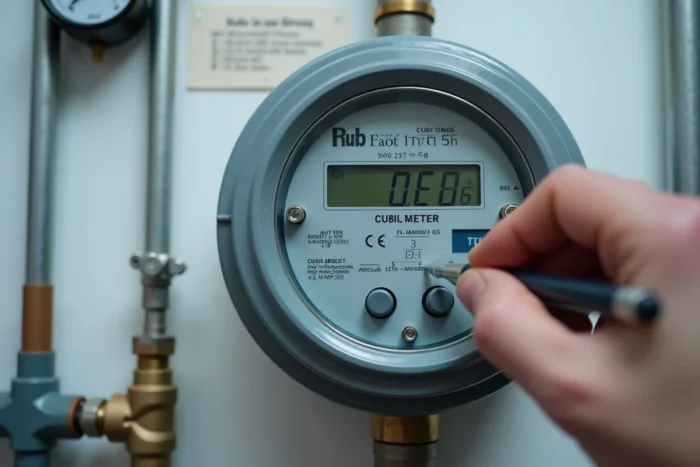
Check the conversion on your gas bill yourself
The verification takes less than a minute. Record the starting index and the ending index indicated on your bill, then calculate the difference to obtain the volume in m³. Multiply this volume by the conversion coefficient mentioned on the same document.
- If the result matches the billed kWh (to the nearest rounding), the conversion is correct.
- If the discrepancy exceeds a few kWh, check that the coefficient used corresponds to that published by GRDF for your municipality during the billing period.
- If doubts persist, ask your supplier for the details of the calculation with the references of the monthly coefficient.
The conversion coefficient is the only variable you do not control in the calculation of your bill. The volume depends on your consumption, the price of kWh depends on your contract, but the coefficient is imposed by the network manager. Regularly checking it remains the most reliable way to ensure that the bill reflects the reality of your consumption.