We’ve all experienced that moment: a pus-filled pimple appears the day before an important meeting, and the immediate reflex is to touch it. The problem isn’t the pimple itself; it’s what we do with it. If not managed properly, a pus-filled pimple can leave a pigmentation mark that takes weeks to fade, or even a permanent scar. When treated correctly, it can resolve in a few days without leaving a visible trace.
Facial Triangle and Pus-Filled Pimple: The Area You Shouldn’t Touch
Before discussing methods, we need to talk about anatomy. The area between the bridge of the nose and the corners of the mouth, sometimes referred to as the “triangle of death” in dermatology, has a venous network that communicates directly with the cavernous sinus at the base of the skull. Popping a boil or a deep pimple in this area can lead to bacterial dissemination to the meninges.
This is not a theoretical scenario. Recent dermatological recommendations emphasize this point: never pop a deep facial pimple yourself, especially in this triangle. For a pimple located elsewhere (chin, forehead, back), the risk of infection remains real but is less critical.
So, we remember a basic rule: if the pimple is hard, deep, painful to the touch, and located between the nose and mouth, we consult a doctor. For other cases, several techniques to eliminate a pus-filled pimple can help speed up healing without worsening the situation.
Enriched Hydrocolloid Patch: The First Step for a Pus-Filled Pimple
Hydrocolloid patches are not new, but their formulation has changed. Current versions incorporate active ingredients like salicylic acid or niacinamide directly into the patch. The principle: the dressing absorbs pus through capillarity while delivering a keratolytic agent that accelerates skin renewal.
A patch applied as soon as the white head appears reduces the risk of pigmentation marks compared to manual extraction. It should be left in place for several hours, ideally overnight, without touching it.
The advantage over a warm compress or a traditional localized treatment is the barrier effect. The patch physically prevents you from fiddling with the pimple, which remains the primary cause of post-acne scars. It is removed in the morning, the area is cleaned, and the state of the pimple is assessed before deciding if a second patch is necessary.
What the Patch Does Not Do
An hydrocolloid patch does not treat a subcutaneous cyst or a deep boil. If the pimple does not have a visible white head, the patch has nothing to drain. In this case, we switch to a warm compress applied for about ten minutes to bring the contents to the surface, then reassess.
Localized Treatments with Salicylic Acid and Benzoyl Peroxide: Choosing the Right Active Ingredient
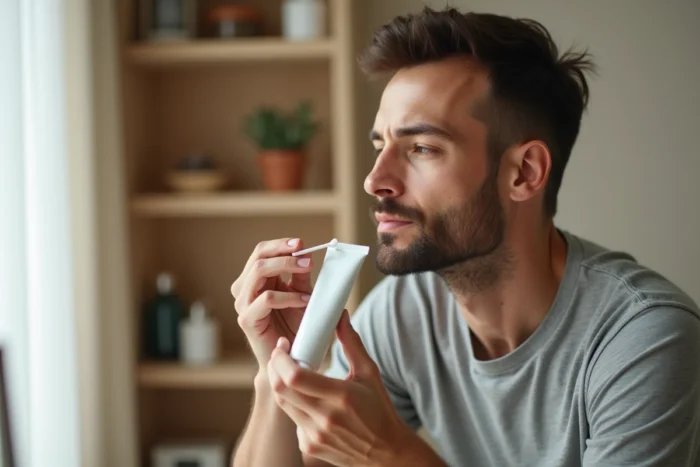
These two active ingredients dominate over-the-counter anti-pimple treatments, but they work differently. Salicylic acid is lipophilic: it penetrates the pore, dissolving the sebum and dead cells that clog the canal. Benzoyl peroxide, on the other hand, is an antibacterial that kills the bacteria responsible for the infection.
- On a white pimple with little surrounding inflammation, salicylic acid is usually sufficient to speed up pus evacuation.
- On a red, swollen, painful pimple, benzoyl peroxide targets the bacterial component and reduces inflammation more quickly.
- Both active ingredients can be used alternately (morning/evening), but applying them simultaneously to the same area often causes irritation that delays healing.
The localized treatment should be applied in a thin layer, only on the pimple, not on the healthy skin around it. Benzoyl peroxide can bleach fabrics and pillowcases, which should be anticipated.
After the Pimple: Protecting the Skin to Avoid Post-Inflammatory Marks
The majority of marks left by a pimple are not indented scars but post-inflammatory hyperpigmentation. The skin, weakened by inflammation, produces excess melanin in response to sun exposure. This phenomenon is even more pronounced on tanned and dark skin.
Applying a high SPF sunscreen every morning to the affected area remains the most effective gesture to prevent a mark from settling in. This advice may seem basic, but it is consistently underestimated: we protect the skin from the sun throughout the healing phase, even on cloudy days, even in winter.
Blue and Red LED Light: A Documented Complement
At-home anti-acne LED devices (blue light for antibacterial action, red light for inflammation reduction) are starting to be integrated into skincare routines. Recent studies show a measurable reduction in healing time when LED is combined with localized treatment.
Feedback on this point varies depending on skin type and the intensity of the device. It is not a miracle treatment, but a complement that can shorten the inflammatory phase by a few days, especially on recurring pimples.
Common Mistakes That Turn a Pimple into a Scar
We know the usual advice (“don’t touch your pimples”), but some less obvious mistakes deserve to be highlighted.
- Exfoliating the active area with a scrub worsens inflammation and can break the wall of the pimple beneath the skin, spreading the infection to neighboring pores.
- Applying toothpaste, an old persistent remedy, dries out the surface but irritates the skin to the point of causing contact dermatitis, adding inflammation to inflammation.
- Disinfecting with pure alcohol destroys the protective skin flora and delays healing. A mild antiseptic (chlorhexidine) is preferable if you need to clean a spontaneously ruptured pimple.
- Covering a ruptured pimple with thick makeup without prior disinfection traps bacteria under an occlusive layer and encourages relapse.
The most protective reflex remains the simplest: clean, treat locally, cover with a patch, protect from the sun. Four steps, in this order, that are sufficient in the vast majority of cases to eliminate a pus-filled pimple without visible consequences.