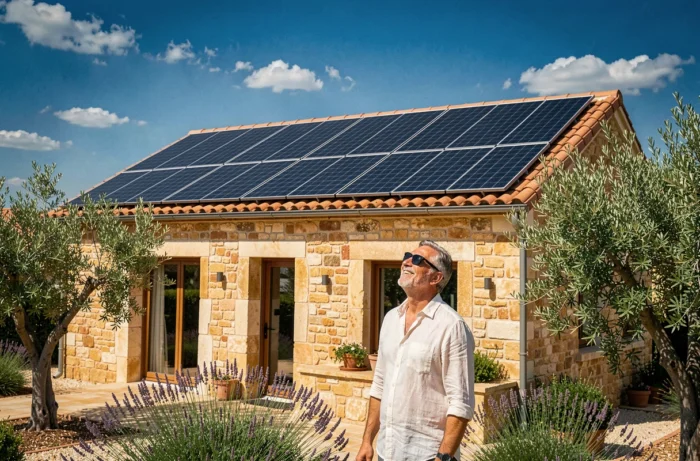
When you live in a house in the Var with an electric water heater and reversible air conditioning, the bill quickly rises between June and September. Installing solar panels on this type of roof changes the game because production coincides with peak summer consumption.
The department accumulates over 2,800 hours of sunshine per year, which is nearly 50% more than the national average. This figure directly translates into kilowatt-hours saved on the bill.
Solar self-consumption in the Var after the reform of June 2026
Since the decree of June 1, 2026, the buyback rate for surplus has dropped to 1.1 euro cents per kilowatt-hour, down from over 12 cents at the beginning of 2025. The self-consumption bonus for installations under 100 kWc has been removed in the process. In practice, selling surplus has almost no financial interest.
The economic model now relies on the kilowatt-hours that one consumes oneself. In the Var, this logic works better than elsewhere: the extended sunshine allows for a wide range of production hours, including in the mid-season. A household that schedules its water heater, washing machine, and pool pump during the day captures a much higher share of its own production.
The benefits of solar panels in the Var are therefore measured first in avoided bills, not in resale income. Specifically, a household equipped with a well-oriented 3 kWc installation (south-facing, slope around 20 to 30 degrees) can produce between 4,200 and 4,800 kWh per year in this department, according to local installers’ field data.
5.5% VAT on residential solar installations: real conditions
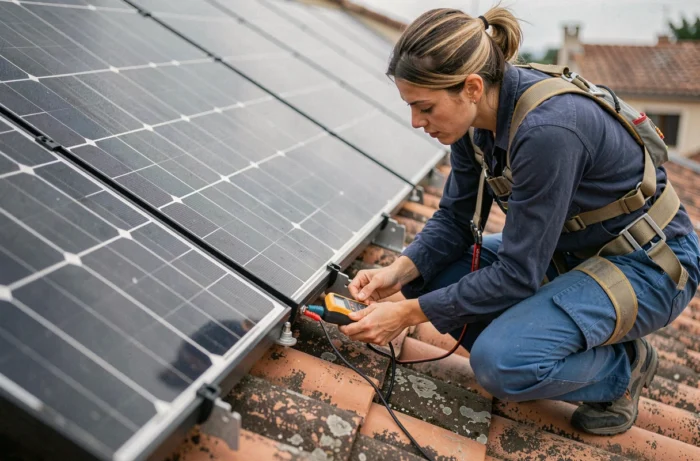
Since October 1, 2025, photovoltaic installations of less than 9 kWc installed on a residential property can benefit from a reduced VAT rate of 5.5%. This rate significantly lowers the initial cost, but it is subject to two specific technical requirements.
- The installation must include an energy management system (EMS) capable of controlling at least two distinct uses (for example, the water heater and the charging of an electric vehicle).
- The panels used must have a carbon footprint of less than 530 kg CO₂ equivalent per kWc, which excludes certain modules manufactured outside Europe with a carbon-intensive energy mix.
- Only certified RGE (Recognized Environmental Guarantee) installers can benefit from this reduced rate, which remains a non-negotiable selection criterion for the quote.
Obtaining this reduced VAT therefore requires checking the technical specifications of the panels and ensuring that the quote includes a control system. Feedback varies on this point: some installers include the EMS by default, while others charge it as an option.
Home battery and solar control: what it changes in daily life
Without a battery, a typical household self-consumes between 30 and 40% of its photovoltaic production. The rest goes to the grid for a negligible rate since June 2026. Adding a home battery raises the self-consumption rate above 70%, sometimes even more depending on the household’s habits.
In the Var, where solar production spans a wide time range, the battery stores the surplus from midday to power the air conditioning in the late afternoon or evening. This gap between peak production and peak consumption is the most profitable use case for a residential battery.
Physical battery or virtual battery
The physical battery (such as Tesla Powerwall or equivalent) is installed in the garage or technical room. Its cost remains significant, and the payback period depends on the difference between the price of purchased electricity and the value of the stored and then consumed kWh.
The virtual battery works differently: the surplus injected into the grid is counted as credit, reusable when production is insufficient. No equipment to install, but a contract with a provider that offers this service. This option is suitable for households that do not want to manage additional equipment.
Specific installation constraints for Var roofs
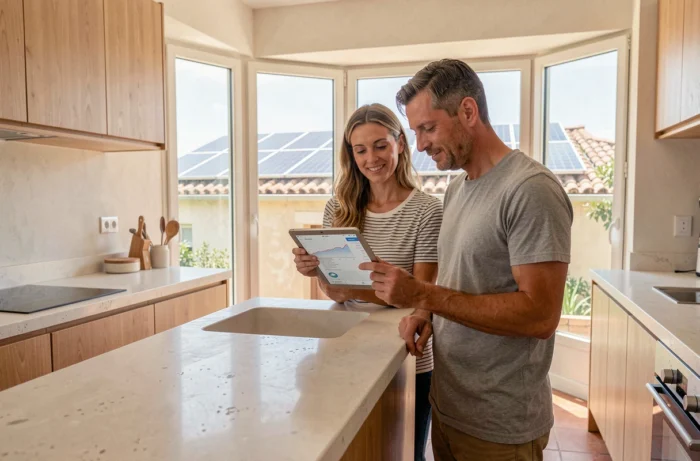
The Var combines intense sunshine and episodes of mistral winds that require reinforced fixings. Overlay installation (panels fixed above the tiles) is now the recommended standard: it ensures better ventilation of the modules, which limits performance loss due to overheating during summer heatwaves.
Integration into the building, previously encouraged by higher buyback rates, no longer has a financial advantage since the reform. It also exposes to risks of infiltration if the waterproofing is not perfectly executed. Overlay installation remains the most reliable choice for a house in the Var.
A often overlooked point: the high temperatures in July and August reduce the performance of the panels. A module loses some performance points when its surface temperature exceeds 25 °C, and in the Var, this value is regularly exceeded in summer. The natural ventilation provided by overlay installation partially compensates for this loss.
Solar production and property valuation in the Var
Beyond the electricity bill, a photovoltaic installation improves the energy performance diagnosis (DPE) of the property. In a tight real estate market like that of the Var coast, moving from an E label to a D or C label thanks to renewable energy production can make a difference during a sale.
Buyers now look at the DPE even before visiting. A property equipped with solar panels attracts more buyers and can justify a higher price per square meter, especially if the installation is recent and covered by the manufacturer’s warranty.
It is also noted that solar panels of less than 9 kWc in self-consumption with surplus sale benefit from an income tax exemption for the generated revenue. This point remains valid even with the new very low buyback rate, and it simplifies administrative management for owners.
The Var therefore combines technical, fiscal, and climatic conditions that make residential solar particularly suitable. With the end of the resale-based model, it is the ability to consume one’s own production that determines the real profitability of an installation, and the sunshine in the department directly benefits Var households.