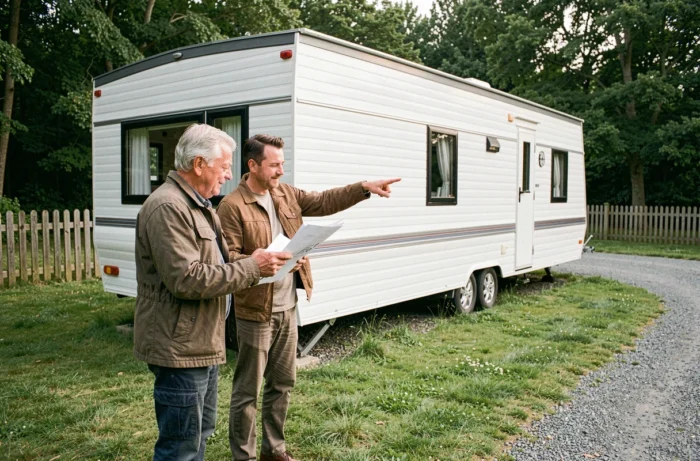
A buildable plot, a mobile home ready to be delivered, and yet the project is stalled at the town hall. The buildability of a parcel does not guarantee the right to place a mobile leisure residence there. The urban planning code, the local PLU, and the legal qualification of the mobile home form a trio of conditions that every project holder must verify before any installation.
Buildable land and mobile homes: why the parcel is not enough
The most widespread misconception is that a plot classified as buildable automatically allows for the installation of a mobile home. Field reports show the opposite. The PLU can prohibit mobile residences even in buildable areas, as the land’s intended use (collective housing, economic activity, public facilities) takes precedence over the mere status of buildability.
Several local parameters can block a project even if it is located on a buildable parcel:
- The zoning regulations of the PLU may require a permanent construction and exclude lightweight leisure housing or mobile residences.
- Public utility easements (protection perimeter of a historical monument, flood zone, air corridor) are added to the PLU and can make installation impossible.
- The absence of connections to utilities (water, sanitation, electricity) on the parcel prevents development, even if the land is theoretically buildable.
The regulation of mobile homes on private land thus requires a cross-reading between municipal zoning, easements, and the technical conditions of the parcel. A buildable plot is just a starting point, not a green light.
Legal qualification of the mobile home: the criterion that determines your steps
Before even consulting the PLU, the first question concerns the legal status of your mobile home. The urban planning code distinguishes several categories, and the procedures vary according to the qualification, not just according to the area.
| Legal Qualification | Criteria | Authorized Locations | Required Authorization |
|---|---|---|---|
| Mobile leisure residence (RML) | Wheels and towing bar retained, movable without disassembly | Camping, PRL, holiday village | None on authorized site |
| Removable residence (ALUR law, minimum occupancy 8 months/year) | Light housing constituting the main residence | Land in a buildable zone or STECAL sector of the PLU | Prior declaration (area ≤ 40 m²) or development permit (beyond) |
| Mobile home requalified as construction | Mobility removed, permanently connected to utilities, placed on a slab | Buildable land compliant with the PLU | Prior declaration (5 to 20 m²) or building permit (beyond) |
A mobile home that retains its wheels and towing bar remains an RML under Article R.111-37 of the urban planning code. Its installation on private land outside of camping, PRL, or holiday village is then prohibited, regardless of the nature of the land.
On the other hand, as soon as the mobile home loses its mobility (wheels removed, placed on a slab, permanent connection), it falls under the regime of conventional constructions. The loss of mobility transforms the legal regime of the mobile home, triggering urban planning authorization obligations proportional to the created area.
Three-month tolerance on private land: what the urban planning code really allows
The temporary parking of a mobile home on private land for less than three months per year is subject to a tolerance, often misinterpreted. This duration does not create a right to habitation. It corresponds to occasional leisure use, without any particular formalities with the town hall in most cases.
Two limits frame this tolerance:
- The municipal urban planning regulations may prohibit any parking of mobile residences, even temporary. Verification at the town hall remains the first reflex.
- Exceeding three months, even by a few days, shifts the installation into the common law regime, with an obligation for prior declaration or permit depending on the area and use.
Exceeding three months without authorization exposes one to a formal notice and fines. Municipalities have means of control and sanctions, including the obligation to restore the land.
ALUR law and STECAL sectors: an opening under strict conditions
The ALUR law of 2014 introduced the possibility for municipalities to create limited size and capacity reception sectors (STECAL) in their PLU. These zones allow for the accommodation of removable residences constituting the permanent habitat of their occupants.
This provision does not apply automatically. Each municipality freely decides whether or not to create STECAL sectors, and many have not done so. The ALUR law opened a regulatory possibility, not a universal right. Before purchasing land counting on this provision, consulting the current PLU remains the only reliable verification.
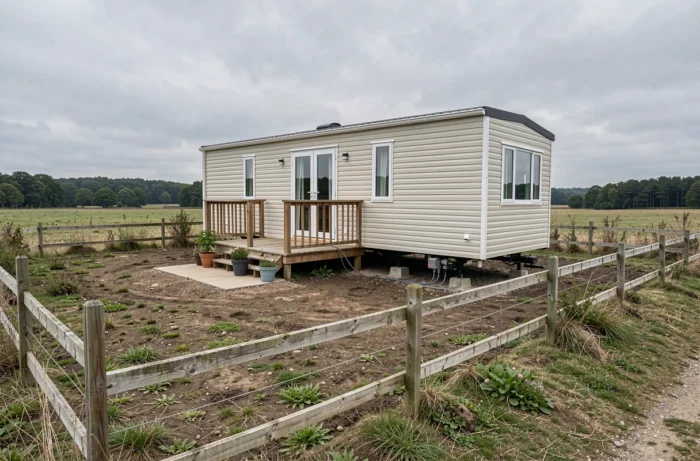
Housing tax, property tax, and mobile homes: what tax regime on private land
The tax regime directly depends on the chosen legal qualification. A mobile home that remains a mobile leisure residence, installed in a camping or PRL, is not subject to property tax. However, it may be subject to the tourist tax depending on the municipality.
As soon as a mobile home is requalified as a construction (loss of mobility, durable connection), property tax and development tax become payable. The development tax is calculated at the time of granting the urban planning authorization. Its amount varies according to the taxable area and the municipal and departmental rates.
For a removable residence under the ALUR law, the tax situation depends on the municipality and local interpretation. Consulting the local property tax office allows for clarification before purchase.
The legal framework for mobile homes on private land relies on three preliminary verifications: the exact qualification of the mobile home, the compliance of the land with the municipal PLU, and the applicable authorization regime. None of these steps can be bypassed by the mere buildable nature of the parcel.