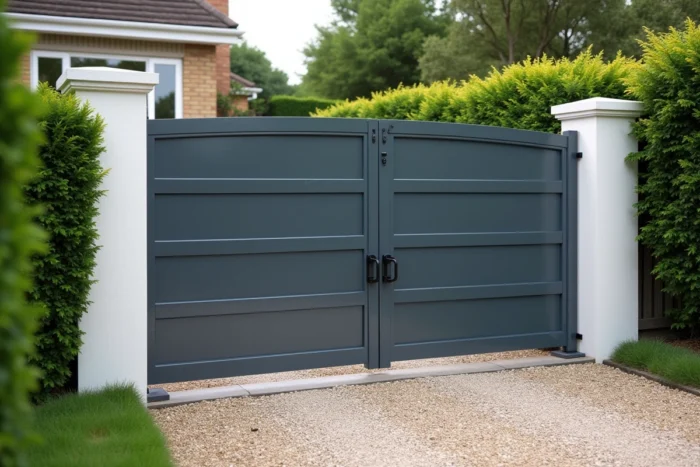
The color of an outdoor gate is not chosen from a color chart in a store. It is determined by crossing the RAL reference chosen by the manufacturer, the constraints of the Local Urban Plan, and the behavior of the shade under UV radiation over time. We will detail the technical parameters that really matter to avoid regretting your choice five years later.
RAL Reference and Finishes: What the Color Chart Doesn’t Show
Custom aluminum gates are now offered in an expanded RAL range, far beyond the classic RAL 7016 (anthracite gray), RAL 9005 (black), or RAL 9016 (white). Some manufacturers provide access to nearly the entire RAL Classic color chart, which includes over 200 references.
Choosing the shade is not enough. The finish radically alters the appearance of the same RAL reference. A satin RAL 7016 appears lighter and softer than a textured matte finish. Matte finishes better conceal micro-scratches and fingerprints, but they attract more dust. The sanded finish, increasingly in demand, mimics the feel of natural stone and ages well outdoors.
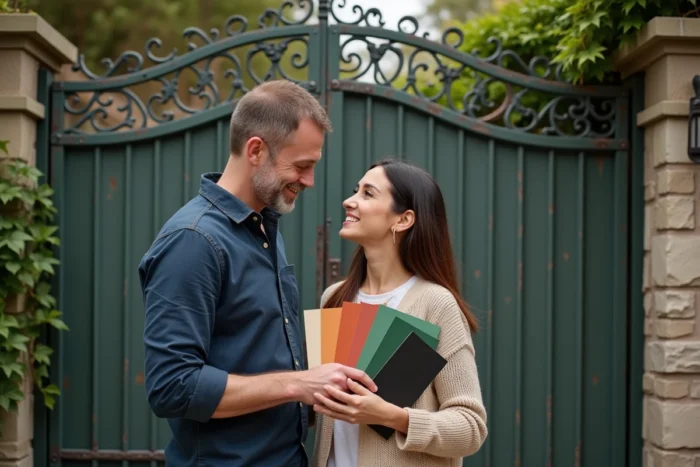
We recommend always requesting a physical sample from the manufacturer and observing it at three different times of the day: the low morning light, the full midday sun, and the warm evening light. A gray perceived as neutral under neon can sometimes take on bluish or greenish hues in natural light. To delve deeper into the criteria to consider, a comprehensive guide helps to choose the right color for your gate according to its environment.
Gate Color and Local Urban Plan: Check Before Ordering
The Local Urban Plan often imposes a limited palette for fences and gates. Some municipalities restrict choices to two or three color families, while others prohibit bright colors or require consistency with the facade’s joinery. In protected areas (ABF perimeter, classified site), the Architect of Buildings of France can refuse a color that does not match the local color chart.
Failing to consult the Local Urban Plan before ordering exposes you to a formal notice. The gate will then need to be replaced or repainted at the owner’s expense. The process takes a few minutes at the town hall or on the urban geoportal website.
Points to Check in the Regulations
- The list of permitted colors for fences, often expressed in RAL families or descriptions (gray, off-white, dark green, wood tone)
- The possible requirement to coordinate the gate with the shutters, garage door, or front door
- Specific restrictions in subdivisions, which sometimes add to the Local Urban Plan through the developer’s specifications
- The protection perimeter of historical monuments, which requires ABF validation within a defined radius around the monument
Aluminum Gate: Color Retention Over Time and UV Exposure
A quality industrial coating (thermoplastic coating with Qualicoat label or equivalent) ensures color retention over time. Dark colors (black, anthracite gray, midnight blue) absorb more solar radiation. A gate facing south in a dark shade heats up significantly more than a light-colored gate, which accelerates the aging of the sealing joint on motorized gates.
Light shades, on the other hand, reveal dirt more quickly: pollen, dirt splashes, rust streaks from nearby metal parts. A medium gray (RAL 7039 or RAL 7030) offers a good compromise between UV resistance and dirt concealment.
Textured Shades and Wood Imitation
Wood imitation finishes (like golden oak, walnut, or gray cerused) are gaining ground. They are achieved through sublimation or transfer film on aluminum. The result is convincing from a distance, but the durability of the film depends on the quality of the process. We observe that sublimation films resist delamination better than glued films, especially in hot climates or exposed to sea salt.
Coordinating the Gate with the Outdoor Environment: Beyond the Facade
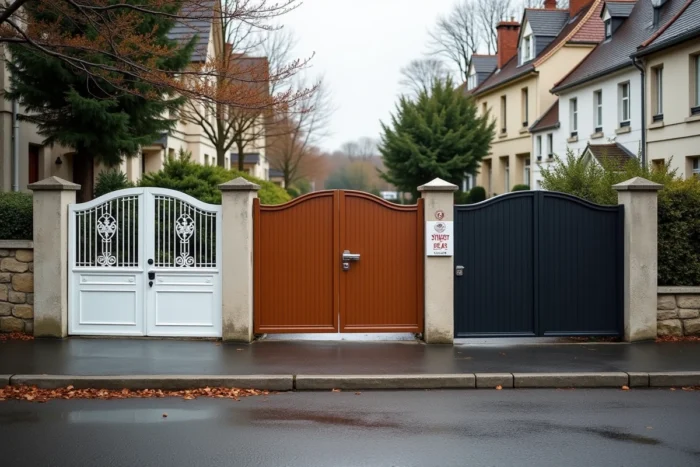
Consumer articles often limit themselves to opposing harmony and contrast with the house. The reality on the ground is more nuanced. The color of the gate interacts with several elements that do not appear on any architect’s plan.
- The driveway surface (light gravel, black asphalt, stone-colored pavers) alters the perception of the gate’s color through direct contrast
- The surrounding vegetation: a dark green gate disappears behind a hedge of cypress, while a light gray gate stands out against a backdrop of laurels
- The outdoor furniture and pergola, if visible from the street, create continuity or a break depending on their color
The current trend favors a visual continuity between the interior and exterior. Warm tones (terracotta, ochre, sage green, warm gray) extend the palette of the garden and terrace rather than creating a sharp break with the street. This approach works particularly well when the gate is associated with a composite fence or a reconstituted stone wall in the same tones.
Bicolor or Monochrome
Some manufacturers offer a bicolor gate: one color on the street side, another on the garden side. This option allows for two different logics. On the street side, a sober color in compliance with the Local Urban Plan. On the garden side, a more personal shade, coordinated with the furniture or terrace.
The additional cost of a bicolor option varies by manufacturer but remains moderate compared to the total price of a motorized aluminum gate. It is an option to consider when local regulations impose a neutral color that does not match the decorative intent of the garden.
The final choice depends on the combination of the RAL reference available from the manufacturer, local urban planning rules, and the actual behavior of the shade against UV and dirt. A sample observed on-site remains the best decision-making tool, far ahead of any online simulator.