
The concept of the ideal male size is based on a mix of anthropometric data, cognitive biases related to dating apps, and industry standards (modeling, ready-to-wear, casting). We observe that the debate often polarizes around numerical thresholds without questioning the mechanisms that produce them. Understanding these mechanisms allows us to distinguish between what is objective measurement and what is social construction.
Measurements and modeling: the criteria of male fashion agencies
Modeling agencies apply strict measurement grids that have nothing to do with any universal “ideal size.” These grids serve a technical purpose: to standardize profiles for campaigns and castings. The minimum height required for men in commercial modeling is generally above the national average, but the exact threshold varies by segment (haute couture, e-commerce, advertising).
What matters more than raw height are the proportions. Agencies evaluate the inseam length relative to total height, chest circumference, and shoulder width. A profile with balanced measurements will be selected more easily than a candidate who is simply tall but disproportionate.
When we talk about the ideal size for a man, we are therefore situated at the intersection of several frameworks that do not converge. The modeling framework does not reflect either the declared preferences of the general public or the statistical averages of a given population.
- In men’s fashion, the path to castings goes through criteria of height, but also inseam, shoulder width, and photogenicity, which relativize the importance of height alone.
- Recent advertising campaigns incorporate more varied profiles under the influence of body positivity, which broadens the range of sizes accepted by some agencies.
- Standardized ready-to-wear remains calibrated to average sizes, not the extremes of modeling, creating a gap between the projected image and clothing reality.

Dating apps and the bias of the “height premium”
Research by sociologist Jean-François Amadieu (University of Paris 1), who analyzed internal data from OKCupid, shows that taller men receive more messages. The height premium exists, but it does not operate in a vacuum.
The effect of height diminishes when the profile highlights personality or social status. On a quick swipe with a single photo and little text, height weighs heavily. As soon as the profile becomes richer, other criteria take over. This observation challenges the idea of a magic threshold above which everything unlocks.
We observe a methodological bias that is rarely discussed: app data captures declared preferences in a context of ultra-rapid sorting. They do not measure the actual weight of height in forming a lasting couple. Confusing the two is akin to deducing the dietary preferences of a population from a fast-food menu.
The height filter as a cognitive shortcut
Some platforms offer a height filter. Users who activate it eliminate profiles even before viewing them. This mechanism transforms height into a binary criterion (above or below the threshold), whereas in offline life, the perception of height adjusts according to posture, morphology, and context.
The filter creates a reinforcement loop: men who receive fewer responses attribute this failure to their height, which fuels the discourse on “ideal height” as a determining factor. Amadieu’s data suggests that this reading is reductive.
Recent generations and the questioning of height norms
Qualitative surveys conducted among 18-30 year-olds in France by sociology labs from ENS and Paris Cité (2023-2024) document a notable evolution. Height is declining in the hierarchy of declared romantic choice criteria among young adults, influenced by the intersecting trends of feminism and the body positivity movement.
These studies find that the traditional requirement for a man to be significantly taller than his partner is weakening. Interviews published in research reports on online romantic socialization reveal a more critical discourse on what some researchers call the “tyranny of height.”
A gap between internalized norms and expressed discourse
The reported decrease in the importance of height does not mean its disappearance. We observe a gap between what respondents claim to value (personality, humor, values) and the behaviors observed on platforms. This gap is classic in the sociology of preferences: norms evolve faster in discourse than in practices.
The renegotiation is real, but it remains uneven across social environments and geographical contexts. The body positivity discourse circulates massively online, but less so in certain environments where pressure on male physical appearance remains strong.
Average height in France and anthropometric evolution
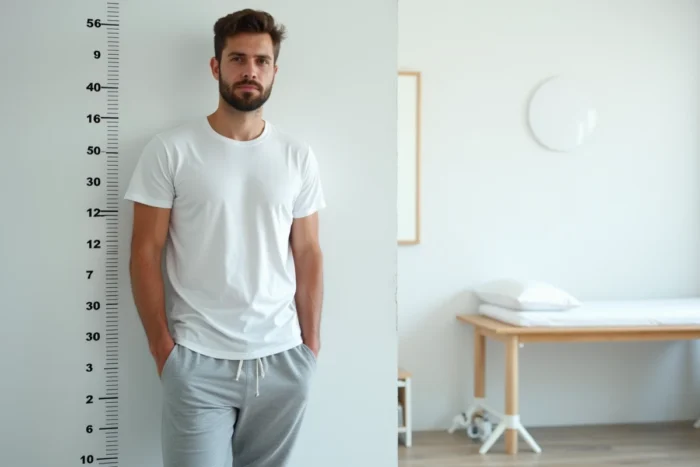
The average height of French men continues to progress slightly from one generation to the next, according to data reported by several national media outlets. This progression, linked to improvements in nutritional and health conditions, is slowing compared to previous decades.
This slowdown interests anthropologists: it suggests that the population is approaching a genetic plateau for current living conditions. Talking about “ideal height” without integrating this generational dynamic amounts to freezing a mobile norm.
Fashion adapts to this reality. A survey by La Mode Française indicates that bodies are transforming and that clothing follows suit. Standardized sizes in ready-to-wear are evolving, proving that the clothing framework itself does not rest on a fixed ideal but on shifting averages.
A man’s height cannot be reduced to a casting number, a filter threshold on an app, or a national average. Each framework produces its own norm, and none claims to define a universal ideal. Recent sociological data confirms that younger generations are integrating this plurality, even if practices are slowly catching up with discourse.