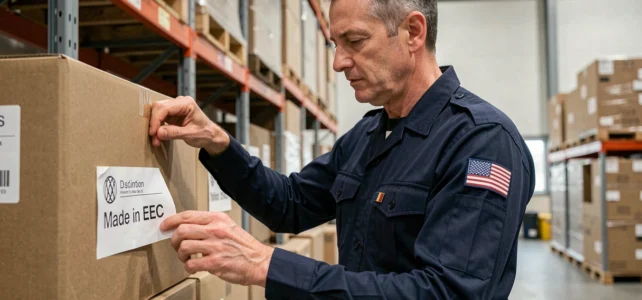
The marking “made in EEC” refers to a time when the European Economic Community structured trade exchanges on the continent. Since the transformation of the EEC into the European Union in the early 1990s, this mention has gradually disappeared from labels. Understanding what this marking encompassed, and what has succeeded it, allows us to measure the evolution of the rules of origin applied to products manufactured on European soil.
Customs Regulation and the Notion of Last Substantial Transformation
European law has never created an official “made in EEC” label nor, today, a harmonized “made in EU” label. The origin of a product is based on the Union Customs Code (Regulation (EU) 952/2013), which retains the criterion of last substantial transformation.
A good is considered to originate from the country where it underwent its last significant manufacturing operation, in a facility equipped for this purpose, resulting in a new product or representing an important stage of manufacturing.
This technical criterion explains why two products assembled in two different EU countries can legally bear distinct origin markings. The marking “made in EEC” already operated according to this customs logic, long before the current codification.
To better understand the origin of made in EEC, it is necessary to distinguish the customs framework (which determines origin for customs duties and trade statistics) from the consumer framework (which protects the consumer against misleading claims).

Made in EEC, made in EU, made in France: Comparative Table of Origin Marks
The origin markings circulating in Europe respond to different legal and commercial logics. The table below summarizes their main characteristics.
| Mark | Geographical Scope | Legal Basis | Mandatory Status | Current Status |
|---|---|---|---|---|
| Made in EEC | European Economic Community (6 then 12 countries) | EEC rules of origin | Optional (non-food products) | Obsolete since 1993 |
| Made in EU | European Union (27 countries) | Regulation (EU) 952/2013, Directive 2005/29/EC | Optional | In use, without an official harmonized label |
| Made in France | Mainland France and overseas | Customs Code | Optional (except for certain food products) | Active, strengthened by the law of August 18, 2026 |
The absence of mandatory status for non-food products has remained constant since the EEC era. In contrast, the consumer framework has tightened: the Directive (EU) 2024/825 known as the Empowering Consumers Directive, applicable from September 27, 2026, strengthens penalties against misleading origin claims.
French Law of August 18, 2026 and Enhanced Traceability
France has taken the lead on the national front. A law of August 18, 2026, now requires private label suppliers to provide documentary evidence of the actual origin of their products. This obligation particularly concerns the food sector, where the mention “origin France” must be supported by verifiable documents.
This text marks a turning point compared to the logic that prevailed under the “made in EEC” marking, where the declaration of origin largely relied on the manufacturer’s self-declaration. Several elements must now be documented:
- The location of the last substantial transformation, with identification of the production facility
- The traceability of the main raw materials, especially for food products
- Certificates of origin issued by customs or the competent chambers of commerce
For manufacturers who once used “made in EEC” as a flexible marking covering the entire common market, the shift to national proof obligations changes the game.
Industrial Accelerator Act and Revitalization of Made in Europe
The debate around the European origin of products took on a new dimension in 2026. The European Commission presented an Industrial Accelerator Act project in early 2026, one of whose axes is to prioritize European companies in public procurement and state aid.
The stated goal is to raise the share of manufacturing industry in the EU GDP to 20% by 2035, up from 14.3% in 2024. This gap of nearly six points illustrates the extent of the decline of European industry since the years when the marking “made in EEC” accompanied a denser productive fabric on the continent.
Member states remain divided on the scope of this European preference, particularly regarding whether it should apply to countries bound by free trade agreements.
Eligibility Criteria for “Buy European”
The project provides for local content thresholds to determine whether a product can benefit from preference in public markets. These criteria recall, on a more ambitious scale, the logic of “last substantial transformation” inherited from the EEC era. The priority sectors identified by the Commission include:
- Clean technologies (batteries, solar panels, heat pumps)
- Steel, cement, and aluminum
- Automotive and critical raw materials
If this framework is adopted, the mention “made in Europe” could acquire legal value in public procurement, which “made in EEC” has never had.
From EEC to EU: What the Evolution of Marking Reveals About the European Economy
The transition from “made in EEC” to “made in EU” is not merely a change of name. It reflects three decades of enlargement (from 12 to 27 countries), partial deindustrialization, and the complexity of supply chains. A product labeled “made in EEC” in the 1980s statistically had a shorter and more geographically concentrated production chain than a “made in EU” product in 2026.
Recent crises (Covid-19 pandemic, war in Ukraine) have highlighted the continent’s dependence on external suppliers for goods deemed strategic. It is in this context that the notion of European preference imposes itself in the current economic debate. The question is no longer just where a product was manufactured, but whether Europe still has the industrial capacities to manufacture it.